
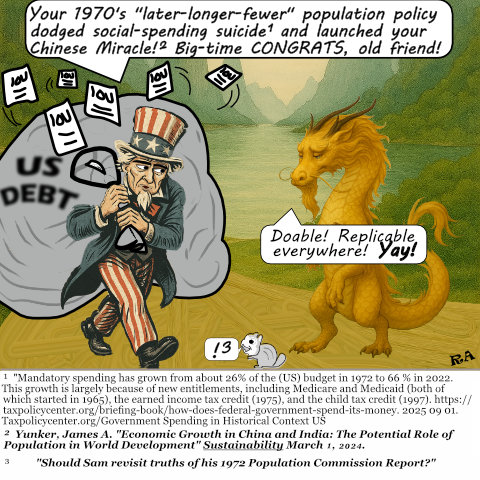
Chinese population successes were shaped as growth of heavy industry and agricultural output were sought to counter fears of invasion from outside.
Chinese population successes began in the 1950s as heavy industry and agricultural development sought to strengthen national defense.
During the 1950s Chinese pronatalist policy prohibited abortion with the result that Chinese numbers, understood initially as availability of manpower, grew quickly. 1
China impemented her initial five year plan as a revolutionary expansion of heavy industry and agricultural development for the purposes of building Chinese strength against outside interference. Initial efforts at socializing the Chinese economy continued through the end of the first Chinese Five-Year Plan. But as the 1953 census confirmed a fast growing population of 600 million people, worries grew about how best to prioritize defense industrialization and farm production.
Mao Zedong’s continued Marx’s criticism of Malthusian notions by attacking “bourgeois demographers.” Mao’s destruction of educated leadership (The “Anti-Right Deviation Struggle) during the 1958-1962 Great Leap Forward would be blamed for 70% of the cause of one of the deadliest famines in human history. 2Smil, Vaclav (18 December 1999). “China’s great famine: 40 years later”. BMJ: British Medical Journal. 319 (7225): 1619–1621. doi:10.1136/bmj.319.7225.1619. ISSN 0959-8138. PMC 1127087. PMID 10600969. [/efn_note]
Chinese population successes took another direction as the 1970s approached, though the revolution to strengthen industrial and agricultural development to support national defense remained paramount.
China’s “later, longer, fewer” (wan, xi, shao) population policy was implemented nationwide starting in 1973. This Chinese population success relied on largely voluntary education in favor of four principles, Later marriage, Longer birth spacing, and Fewer births. Typically, marriages were best after 25 years of age for brides, and after 28 years of age for grooms. Longer birth spacing meant waiting periods between children of three to five years. Fewer children were the intended result, thus two children per family, three in rural areas.
Later, longer, fewer was directed at shrinking the danger that agricultural and industrial capital necessary for military protection from outsiders would be exhausted, as in parts of the West, by dependent people.
Later marriage, longer birth spacing, few births policy was thus the precursor to the stricter one-child policy which would be deemed necessary as voluntarism seemed increasingly unlikely to protect dreamed of economic advancement that would later be called, the Chinese Miracle.
Chinese population successes increasingly sought more effective 1970s remedies to protect industrial and agricultural development from shrinking, still, to strengthen national defense against outside threats.
In 1964, faulty U.S. intelligence enabled Johnson’s Gulf of Tonkin Resolution which granted US president Lyndon B. Johnson authority to assist any Southeast Asian country whose government was considered jeopardized by communist aggression. That resolution would serve as Johnson’s legal justification for deploying US conventional forces to South Vietnam and for the commencement of open warfare against North Vietnam in early 1965.
By the 1970s, China, Russia, and neighbors such as Vietnam were constantly reminded of self-defense needs to protect themselves from outsider-imposed military violence.
The Fourth Five-Year Plan (1971-1975) set targets for lower growth in numbers, emphasing later marriage, longer spacing, and fewer conceptions to reduce numeric growth by a 1% rate by the 1980s.
The Fifth Five-Year Plan (1976-1980) and Sixth Five-Year Plan (1981-1985) focused on lifting China’s people out of poverty by reducing the demands of uncontrolled population growth, while continuing to build economic strength capable of supporting military power for self-determination.
As Chinese population successes began to curb numbers of dependent people, the focus of Chinese population success would change.
Chinese population success at reducing fertility allowed two, and later three-children policies, among other efforts to better fine tune population numbers to long-term survivability and male-female numbers.
By the 14th Five-Year Plan (2016-2020) the “heavy lifting” of earlier compulsion had given way to more targetted efforts to boost service sectors, expand social safety nets, while adding to the industrial strength needed to protect ways of life Chinese people have begun to develop. The 15th Five-Year Plan (2026-2030) aims to broadly double the size not of population, but of the Chinese economy between 2020 and 2035.
Chinese population successes as a semi-controlled half-century social experiment.
Economist James A. Yunker cited at footnote two of this Uncle Sam-Golden Dragon plate, wrote an ingenious comparison of Asian-Indian economic growth with accomplishments some have called “The Chinese Miracle.” Viewing half a century of development of both countries as perhaps the world’s largest economic experiment, his analysis considers Chinese population success as the most likely variable accounting for results monumentally favorable to China.
Recent Comments